Synthajoy was DG Compton’s fourth science fiction novel. Previously, he had written half a dozen crime novels under the name Guy Compton. So it should come as no surprise that Synthajoy is as much a crime novel as it is a science fiction novel.
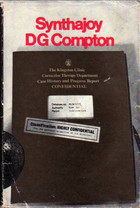
Thea Cadence has been incarcerated in the Kingston, a clinic designed to rehabilitate criminals using the Sensitape process. Thea’s husband, Dr Teddy Cadence invented Sensitape – or rather, he invented the concept. The device itself was invented by Tony Stech, his business partner. Sensitape is, as the name suggests, recorded emotional states which can be played into a person’s mind, and thus directly affect it. At the Kingston, Thea is undergoing Sensitape treatment in contrition as her sentence for a crime.
Cadence had been inspired to invent Sensitape while attempting to cure Stech’s father of an increasingly common condition called UDW, Uncompensated Death Wish. He failed to prevent the man’s death, but Sensitape did subsequently make UDW extremely rare. In fact, Sensitape was a great success. But the recording made of a couple making love, Sexitape, was an even bigger success. Cadence, however, always dreamed of artificially creating the emotions on a Sensitape, i.e., deliberately programming the effect required. He called this process Synthajoy.
Thea drifts in and out of her memories as she is being treated. Though she did not defend herself during her trial, she does not consider herself guilty of the crime. She resists her rehabilitation treatment. And in between periods of introspection and rebellion, she relives – or explains to her nurse – the history of Sensitape and her involvement with it. In this way, facts pertinent to the crime of which she has been charged are revealed.
Thea murdered her husband.
An early Sensitape session in which she was the guinea pig gave her a revulsion for her husband’s body. He found sexual companionship in the arms of another woman – the one from the Sexitape, in fact. Thea meanwhile had an affair with Tony. Who later committed suicide under suspicious circumstances. During her trial, the prosecution claimed it was jealousy that had led to the murder. They did not know of Thea’s relationship with Tony, nor did she tell anyone of it.
Synthajoy is a carefully-plotted ramble through Thea’s consciousness and history. She is hiding the truth from herself as much as she is from her prosecutors and rehabilitators. And it is only as she reveals her past that the truth about Tony’s suicide and the murder of Dr Cadence are uncovered. Unlike later novels, Synthajoy is a single-hander, and told entirely from Thea’s point of view. She is intelligent, educated, middle-class, and beautifully real. Unsurprisingly, the writing is a joy to read:
It is extraordinary to watch my hands. They smooth and fold, now so neat and expert, so accomplished now that they act without mind, without my volition … Hope is like a fever, a heat engendered by battle, and it leaves a deadly chill behind it. My arms ache. My hands tingle and creak. (p 50)
Also, unsurprisingly, the book is very firmly British, and very firmly a novel of the late 1960s / early 1970s. (It was first published in 1968). Those characteristics, as much as the writing, are the essence of Compton’s appeal. His novels are fiercely intelligent and beautifully crafted, but it is their finely-tuned sense of time and place, the way the central ideas are so well integrated into the real world, that makes them stand out.
There are ideas that Compton returns to again and again. The abuse of technology is an obvious marker – and one that demands a story set in as close an analogue of the real world as is possible. And yet… It seems odd that Compton should begin his writing career in crime, writing novels in which the purpose of the story is to explain a death. Yet his science fiction novels typically feature epidemics of unexplainable deaths – UDW in Synthajoy, Gordon’s Syndrome in The Continuous Katherine Mortenhoe (see here), and the Disappearances in Ascendancies (see here).
In his three decades of writing science fiction, Compton never won an award, despite being published regularly in both the UK and the US. The Steel Crocodile was shortlisted for the Nebula in 1971, but lost out to Ringworld (an extremely popular book, but nowhere near as well-written). He appeared on the Locus Award shortlist three times, and in 2007 the SFWA made him an Author Emeritus. Yet he was possibly the best British sf writer of the 1970s. At a time when US authors of the 1950s dominated the field on both sides of the Atlantic – Asimov, Smith, Herbert, Heinlein – Compton was one of a handful of British sf writers writing sf novels so much more intelligent and well-crafted than those of their contemporaries. It’s a shame they appear to be mostly forgotten, and it’s the likes of Foundation and Stranger in a Strange Land which dominate lists of so-called genre classics. Perhaps the re-issue of Compton’s back-catalogue as ebooks through the SF Gateway (Compton’s entry is here), and The Continuous Katherine Mortenhoe‘s appearance in the SF Masterwork series in October 2012, will see Compton receive the recognition he deserves.
The following novels by Compton are currently available on Kindle via the SF Gateway. If you own such a device, you should buy them immediately: Farewell, Earth’s Bliss (1966), The Silent Multitude (1966), The Quality of Mercy (1967), Synthajoy (1968), The Steel Crocodile (1968), Chronocules (1970), A Usual Lunacy (1978), Windows (1979), Ascendancies (1980), Scudder’s Game (1988), Nomansland (1993), Justice City (1995) and Back of Town Blues (1997).


 It Doesn't Have To Be Right...