It Doesn't Have To Be Right…

… it just has to sound plausible


10 Comments

The Battle of the Sexists

So Fabio Fernandes put together a Mind Meld on SF Signal about the Russ Pledge and invited a bunch of very reasonable people and myself to contribute. It prompted a lively comment thread. Many of the comments contained the following “mansplaining” gems:

1. You have the numbers wrong – it wasn’t 4% of the books in the Guardian poll were by women, it’s closer to 12%.

And this is acceptable? According to Niall Harrison’s survey at Strange Horizons, 41.7% of books received by Locus were by women; in the UK, it was 37%. It’s not gender parity, but neither is it around 12%. Books by women sf writers are under-represented. Fact. Stop arguing about numbers and do something about it.

2. Why should I impose quotas on my reading?

Because if you’re part of the problem which results in that 12%, then you need to change your reading habits. You have an unconscious bias. You need to make a conscious effort to break that bias. And if that means imposing a quota on the genders of the authors you read, then that’s what you need to do.

3. A book stands on its own merit.

Right. So you have this magical ability to determine exactly how good every book ever published is, then? You can just look at a book and know it’s going to be good. Maybe that’s because you have a bias towards books by male writers and find them more enjoyable because they confirm your prejudices. Maybe you need to change that bias, and next choose to read a book by a woman writer. Who knows, it might “stand on its own merit” too.

4. I don’t care about the gender of an author.

Of course, you don’t; that’s why there’s an imbalance in the first place, that’s why women writers are under-represented. The fact that you don’t care just means you’ve never taken the trouble to think about your bias. So start thinking about it.

5. Writing by women is at least as good as writing by men.

I know you’re trying to be helpful, but… Writing by women is as good as writing by men. There’s no “at least” in it.

6. What about other under-represented minorities?

Women aren’t a minority – in the US in 2009, there were 155.6 million females and 151.4 million males; in England, 25.2 million females and 23.9 million males (2001 census figures). Women are a majority. Except when it comes to talking about science fiction books. This is not acceptable.

Clearly something needs to be done. Being reasonable is not a solution – all that does is perpetuate the unfairness. And, to be honest, I don’t even understand why people would argue against something that is blatantly unfair. Being asked to take the Russ Pledge does not infringe your human rights, it is not asking you to do something that will cost you money, or may lead to injury. It is asking you to make a conscious choice in one particular aspect of your life. It is asking you to question your own biases. It is asking you to stop being a sexist. And, be honest, how is sexism defensible?

Sadly, this appears to be a situation that few actually care about, or are willing to do something about. After an initial burst of enthusiasm, the hits on SF Mistressworks are now a third of what they were, even though I’ve been posting at least one review a day since the blog started. Most people, it seems, would sooner look at a photograph of John Scalzi’s new car (which is not a slur on John Scalzi himself).

At the beginning of the year, I decided my 2011 reading challenge would be to read, and blog about, a sf novel by a women writer each month. And I’ve been doing that. But next month, I’m going to do more: in July, I will only read books written by women, irrespective of genre. I already have a dozen titles picked out. One of them will be God’s War by Kameron Hurley – because last week on Twitter, Niall Harrison raved about the book and a number of us were persuaded to buy copies. The book was already on my radar – as any sf novel based on Arab culture would be, given my background; and one day, perhaps, I would have got round to buying and reading it. But Niall’s comments were enough to convince to buy a copy there and then. That’s the way this sort of thing should work – for books by women writers just as often as for books by male writers. And yes, I will post something here about God’s War here when I’ve finished reading it.

And, incidentally, I’m still looking for more reviews for the SF Mistressworks blog.

2 Comments

All the news that’s fit to print

Nearly halfway through the year, and time for a little self-promotion – i.e., my magazine and anthology appearances during the rest of this year.

Andy Remic wanted “bizarro fiction” for Anarchy Book’s anthology Vivisepultura, and I certainly hope my story in it qualifies. There’s only one way to find out: buy a copy. Due to be published on 1st August.

I’ll be in The Exagerrated Press’ The Monster Book for Girls, edited by Terry Grimwood, which I believe will be launched at Fantasycon in Brighton in September.

I have a story in Eibonvale Press’ new anthology, Where Are We Going?, edited by Allen Ashley – due to be published in late 2011 / early 2012. The story is my bathypunk one, which was inspired by the one and only descent to Challenger Deep, the deepest part of any ocean , in 1960.

Next month’s Jupiter sf magazine has one of my stories in it. It will be, as far as I’m aware, the only death metal hard sf story ever to see print. It quotes extensively from the lyrics of one of my favourite bands, Mithras (with their permission, of course). Then there’s Alt Hist #3, publication date currently unknown, which will contain one of my stories.

Finally, there’s Rocket Science, the hard sf anthology I’m editing for Mutation Press. The submission period starts on 1st August, so I’m fully expecting to get mailbombed on that date.

For those of you who can’t wait, there’s always ‘Disambiguation‘ on the Alt Hist website, and ‘Barker’ in the Winter 2010 BFS Journal.


2 Comments

It is entirely possible…

… I have too many books. But then, I ask, what is wrong with that? Aside from the issue of space. And the occasional difficulties actually finding the book I am looking for. Not to mention the fact that I can’t read them as fast as I buy them – though some of them are references works and not intended to be read per se.

Anyway, a few parcels have arrived at It Doesn’t Have To Be Right Manor over the past weeks, and here is what they contained:

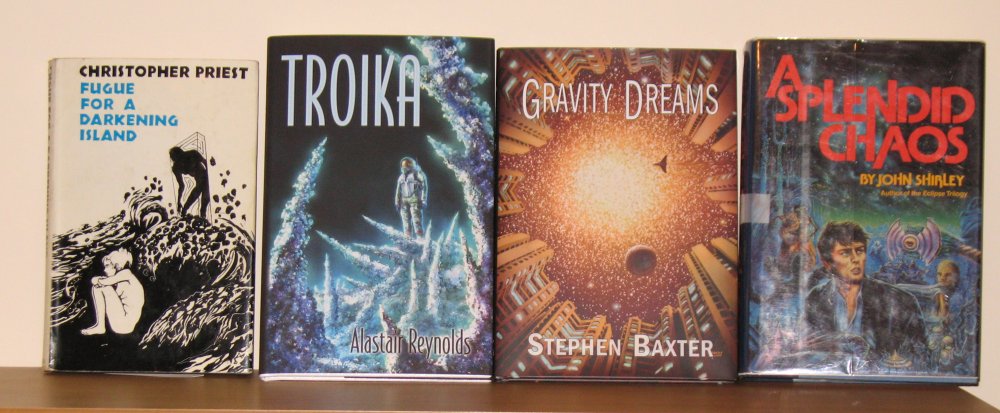
Some first editions to start with: I’ve been after a copy of Fugue for a Darkening Island for a couple of years, but the paperbacks I’ve seen have all been expensive; and then I found this first edition for a fiver… only to be told that Gollancz are soon to publish a revised edition. Gah. Troika is the Subterranean Press edition of the SFBC Alastair Reynolds novella which is on the Hugo Award shortlist. Gravity Dreams is a new Stephen Baxter novella from PS Publishing. And A Splendid Chaos is a signed John Shirley sf novel from 1988.

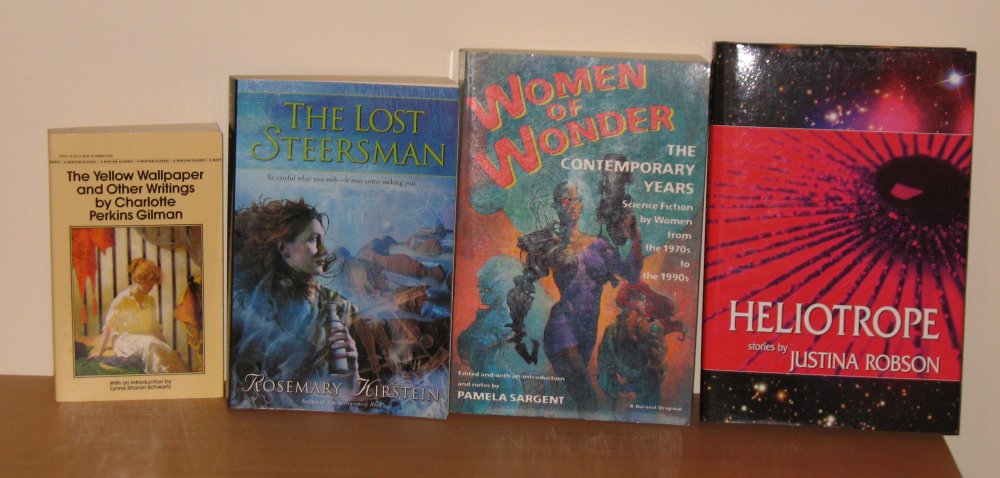
Four books by women sf writers: “The Yellow Wallpaper is a collection of Charlotte Perkins Gilman’s writings, both fiction and non-fiction. The Lost Steersman is the third book in Rosemary Kirstein’s Steerswoman series. I very much enjoyed the first book (see here), but I’m going to have to buy the omnibus of books one and two, The Steerswoman’s Road, before I can read this one. Women of Wonder: the Contemporary Years is an anthology of science fiction by women writers from 1995. And Heliotrope is Justina Robson’s first short story collection, published by Ticonderoga in Australia.

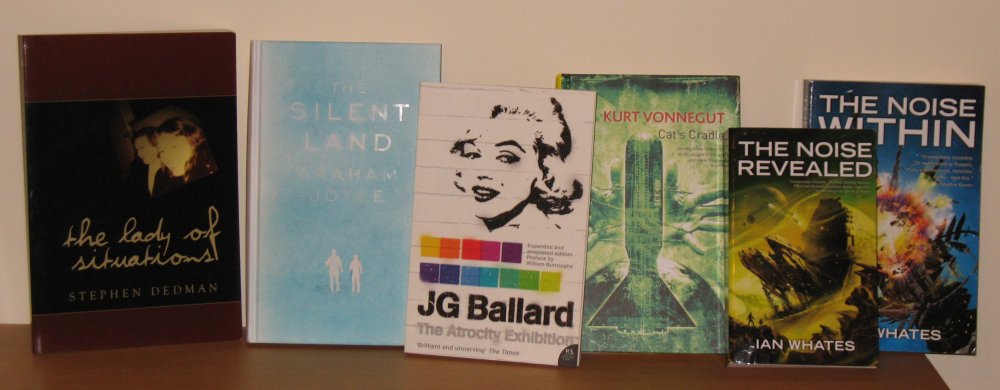
The Lady of Situations is a short story collection by Stephen Dedman, bought from Ticonderoga in the same order as Heliotrope above. The Silent Land I found in Oxfam. I’m expanding my Ballard collection, hence The Atrocity Exhibition. I’ve also been collecting the SF Masterworks series since they first appeared over ten years ago – thus Cat’s Cradle – though I’m not a fan of Vonnegut’s books. The two Ian Whates space operas, The Noise Within and The Noise Revealed, are for review for Vector. A bit annoying, isn’t it, when they release books in a series in different formats…

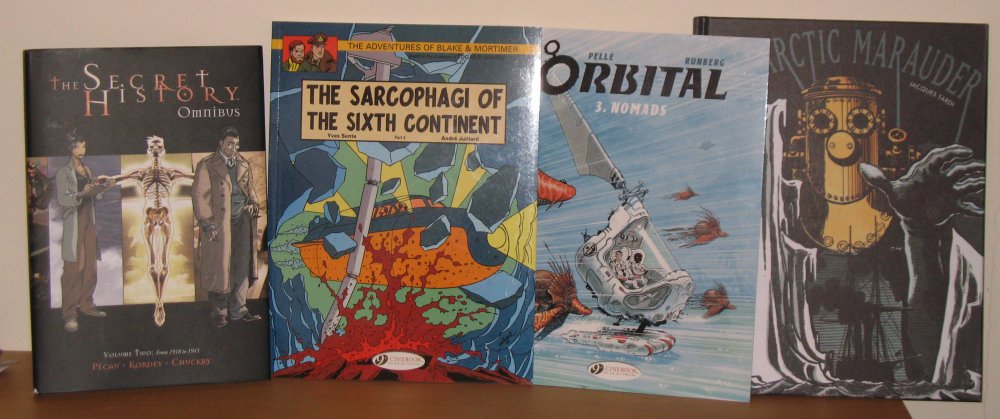
Graphic novels: The Secret History Omnibus Volume 2, written by Jean-Pierre Pécau, covers from 1918 to 1945, and cleverly weaves in real historical events and persons. Good stuff. The Sarcophagi of the Sixth Continent, Part 2, is another episode in the continuing adventures of Captain Francis Blake and Professor Philip Mortimer, this one opening with Mortimer’s childhood in India and finishing up in the late 1950s as a megalomaniac Indian prince attempts to destroy the West from his Antarctica base. Orbital 3: Nomads is the, er, third in a space opera bande desinée series – it looks good but doesn’t actually feel like a whole story. Finally, Jacques Tardi’s The Arctic Marauder is one of Fantagraphics’ new English-language editions of Tardi’s bandes desinée, and is a bonkers Vernesque tale set in the, um, Arctic.

Finally, some books for the Space Books collection. Race to Mars is, bizarrely, a book produced by ITN outlining proposed US and Soviet missions to the Red Planet. I found it in a charity shop. US Space Gear is about, well, spacesuits. The remaining six books I ordered direct from Apogee Books, though I did so specifically because I wanted a book only they had in stock. But they lost my order, and when I queried a few weeks later, they apologised, shipped the books and then admitted that the one book I’d really wanted was now out of stock. Argh. Which is not to say that I didn’t want the rest – Apollo 11: The NASA Mission Reports Volume 3, Apollo 17: The NASA Mission Reports Volume 2, Deep Space: The NASA Mission Reports, Space Shuttle STS 1 – 5: The NASA Mission Reports, Beyond Earth and Interstellar Travel and Multi-Generational Space Ships. Expect reviews of some of these to eventually appear at some point on the Space Books blog (though, to be honest, I’m a little busy with the SF Mistressworks blog at the moment).


2 Comments

For every step forward…

… someone somewhere will be determined to drag you backwards. Everyone is talking about women in sf and the fact they’re appallingly under-represented… and Technology Review goes and publishes a list of The Best Hard Science Fiction Novels of All Time, which includes ten books, only one of which is by a woman sf writer. Sigh.

As if that weren’t enough, number two on their list is that well-known paragon of scientific rigour, The Time Machine by HG Wells. And, of course, there has to be a book by Asimov there too, though thankfully it’s not Foundation. Instead they picked I, Robot. I must admit, I’ve never understand the reverence in which the Three Laws are held. I mean, they’ve never been implemented in robots, there would be no point in doing so – robots, or “computer numerical control” machines, do exactly what their programming instructs them to do, and nothing more. So if you want a robot to kill a person, you simply put that in its instruction set.

As for the rest of Technology Review’s list… they’ve not made entirely embarrassing choices, though I wouldn’t actually classify many of the books on the list as hard sf. Still, as lists of science fiction works go, it’s a pretty poor job.


3 Comments

It’s not just the women of sf

Though I’ve posted here about women sf writers – on both the sf mistressworks list and SF Mistressworks blog – I do read fiction of other genres written by women. And I thought it might be worth mentioning some of the non-sf works by women writers I’ve enjoyed and admired in the past:

Helen Simpson is one of my favourite mainstream short story writers, and has been ever since I came across her story ‘Heavy Weather’ in a collection of modern short fiction (it’s also in her Dear George And Other Stories). Simpson has yet to write a novel but she’s had six collections of short stories published. I have them all.

Given the amount of time I spent in the Middle East, it’s no surprise I’m fascinated by Arab culture – and yet I’ve not read that many Arabic authors. Of the few I have, the best book I’ve read so far is Hanan Al-Shaykh’s Women of Sand and Myrrh. Which reminds me: I must get hold of one of Freya Stark’s books…

Kate Ross wrote four novels set in Regency England featuring an upper-class dandy who turns amateur detective. As crime novels go, they’re a bit fluffy, but the last one, The Devil in Music, is an all together different matter. It is masterfully-plotted, surprisingly dark, and nothing like the consciously-Austenesque comedy of manners that are the earlier three books.

I’ve always preferred female crime writers to male; I’ve no idea why. The best of them is easily Sara Paretsky. But I’d be hard-pressed to pick a favourite VI Warshawski novel. Guardian Angel, perhaps; or Toxic Shock. Hell, just read them all.

Fisher’s Face, Jan Morris, is a sort of biography of Admiral of the Fleet Jackie Fisher, who was instrumental in building up the Royal Navy during the early years of the twentieth century. Fisher was responsible for HMS Dreadnought, the battleship which made every other warship on the planet obsolete the moment it was launched. Fisher’s Face is a fascinating meditation on the man.

You can blame the Acnestis APA for the fact that I’ve read most of Georgette Heyer’s books. Several of the members were fans, and their comments led me to try one of her novels. And so I too became a fan. The history is dubious at best, and some of her later books were a little too romantic for my tastes, but they’re also witty and great fun. I’m not sure I have a favourite – The Talisman Ring, perhaps; or An Infamous Army. It’s proper comfort reading, for when it’s chucking it down outside, there’s nothing on the telly, and you’re feeling a bit down in the dumps.

Years ago in my middle or late teens, while spending the holidays with my parents in the Middle East, the only books I had access to where the ones they’d bought. I worked my way through my father’s handful of thrillers quickly, but then I was stuck. So I picked up one of my mother’s books: MM Kaye’s The Far Pavilions. And I thoroughly enjoyed it. So much so I read her other historical novels and, years later, I tracked down and read her crime novels.

It was the Lawrence Durrell connection which brought Olivia Manning to my attention. She was in Cairo during World War II, as he was, and they both belonged to the same loose group of poets and writers in the city. So I read The Balkan Trilogy and thought it excellent, and then read The Levant Trilogy and thought that excellent too. I even bought the DVD of the BBC adaptation, Fortunes Of War, starring Emma Thompson and Kenneth Branagh. It’s also very good.

Finally, a couple of cheats…

RA MacAvoy is on the sf mistressworks list, but she has written both science fiction and fantasy. And her fantasy trilogy of Lens of the World, King of the Dead, and Winter of the Wolf is very, very good indeed. The books are out of print now, but definitely worth tracking down.

Also on the sf mistressworks list is Susan Shwartz, but she too wrote fantasy as well. Her The Grail of Hearts was a novel I never expected to like as much as I did. The title suggests it’s a fantasy romance, but it’s actually a clever re-telling of the Matter of Britain featuring a female Wandering Jew. It’s also worth hunting down.


5 Comments

SF Mistressworks: one week on

On the 1st June, in response to a call for action by Nicola Griffith, I set up the SF Mistressworks blog, a site devoted to reviews of science fiction books by women writers. I had no desire, nor did I think it was fair, to provide the content entirely by myself, so I put out a call for volunteers. And lots of people responded – over a dozen, at the last count. I also said I was happy to take previously-published reviews, and a number of people subsequently donated old reviews they had written. As a result, in the past seven days I’ve posted fourteen reviews by various hands to the site, and have several days’ worth scheduled. The blog has also been averaging 300 hits a day.

So the response has been very good – better, in fact, than I expected. But there’s a danger interest might fade away as the year progresses. And I don’t want that; I don’t think anyone wants that. So I’m always on the look-out for new reviews and reviewers, and happy to take either (there’s an FAQ on the blog, explaining the sort of thing I’m after). It’s also good if other people promote the blog – link to it, mention it in passing, encourage discussion regarding it, whatever you think is appropriate.

For the record, the following books have been reviewed on SF Mistressworks (each title links to the review):

China Mountain Zhang, Maureen F McHugh
Grass, Sheri S Tepper
Ammonite, Nicola Griffith
The Journal of Nicholas the American, Leigh Kennedy
The Left Hand of Darkness, Ursula K Le Guin
The Female Man, Joanna Russ
Where Late the Sweet Birds Sang, Kate Wilhelm
The Steerswoman, Rosemary Kirstein
The Dispossessed, Ursula K Le Guin
Pennterra, Judith Moffett
The Handmaid’s Tale, Margaret Atwood
Rebel Sutra, Shariann Lewitt
Escape Plans, Gwyneth Jones
Halfway Human, Carolyn Ives Gilman

Still to come, reviews of:

And Chaos Died, Joanna Russ
Hermetech, Storm Constantine
Doomtime, Doris Piserchia
Black Wine, Candas Jane Dorsey
Winterlong, Elizabeth Hand
Starmother, Sydney J Van Scyoc
The Sword of Rhiannon, Leigh Brackett
Queen City Jazz, Kathleen Ann Goonan
The City Long After, Pat Murphy

… plus several more. I also intend to link to the website of as many woman sf writers as I can find, and list those sf books by women writers which have won prizes.

So, keep watching the site.


3 Comments

Women in sf reading challenge #5: China Mountain Zhang, Maureen F McHugh

China Mountain Zhang has been on my radar for a number of years – it’s one of those books I’ve heard many good things about, but have never really got around to buying or reading. Until now. And, in one of those moments of serendipity that confirm you’ve chosen the right time to do something, no sooner had I picked the book for my reading challenge then I found a copy in a local charity shop. It could simply be, of course, that I’d not been looking for it before, but since I’d been wanting to read it for many years I don’t think that’s the case.

Whatever. I’ve now read China Mountain Zhang. And I’m very glad I have done so. It is a very good novel. Zhang Zhong Shan is an ABC, American Born Chinese – except he is not really: his father is Chinese, but mother is Latino and he was genetically-engineered to appear pure Chinese. He is also gay. He works as a construction technician in New York in a United States dominated culturally, economically and politically by communist China. Zhong Shan translate roughly as “China Mountain” and is also the Mandarin equivalent of the Cantonese Sun Yat-sen. It is considered a name worth remarking on: as Zhang himself says, “To be named Zhang Zhong Shen is like being named George Washington Jones” (26).

China Mountain Zhang is the story of Zhang, opening in New York on a construction site, and finishing in New York with Zhang working as a freelance organic engineer. In between, he spends time on Baffin Island and at university in Nanjing. The narrative also breaks away from Zhang on several occasions to tell the stories of Angel, a kite-flyer in New York, and Martine, a settler on Mars. Though both narrative threads seem unrelated, by the end of the novel they have touched, or have been touched by, Zhang.

Not one of the characters changes the world though their lives do so. But neither is this a novel of accommodation – no one changes to in order to fit better. In fact, Zhang finds himself less employable, having qualified as a construction engineer, than he had been as a construction tech. And despite homosexuality being illegal in both the socialist USA and China, Zhang never questions his sexuality.

And yet he questions his racial identity repeatedly. He is not really Chinese, though he appears to be. His mother named him Rafael, and he still uses the name among some of his friends. As China Mountain Zhang opens he has been invited to the home of his foreman Qian to meet his daughter. Qian is Chinese but has fallen from grace and been exiled to the US. He does not know that Zhang is not wholly-Chinese, nor that he is gay. Trapped in the identity he presents to Qian, Zhang reluctantly meets Qian’s daughter, San-xiang, and takes her out. They become friends, of a sort – she imagines more to the relationship than is ever going to be the case.

In a later break-away narrative, Xan-siang, who is not attractive – “She is astonishingly ugly. More than ugly, there is something wrong with the bones of her face” (p12) – has cosmetic surgery to correct her appearance… only to fall victim to a predatory man. Her ugliness had protected her, and now she is pretty she does not have the social skills to cope with the attention her looks now cause. Her story is the one unhappy one in China Mountain Zhang.

But before that, Xan-siang runs away from her parents and goes to stay with Zhang. Her father tries use to this to force them into marriage, so Zhang reveals he is half-Hispanic. Qian fires him. Which is how Zhang ends up working on Baffin Island. There, Zhang’s identity – racial or otherwise – is mostly irrelevant. The scientists of the station are more interested in their jobs. However, Zhang’s six-month stint there does qualify him for special entry into a university in China. Which is where he qualifies as an organic engineer. The sections set in Nanjing don’t seem to quite gel as effectively as those set in New York or even on Mars. Zhang is a foreigner, though he does not look like one, and his personal interactions appear mostly limited to his tutor, also gay and with whom he has a relationship. Admittedly, China Mountain Zhang is Zhang’s story, told from his point of view, so perhaps that’s unfair. Perhaps too it’s because Nanjing follows Baffin Island, and Baffin is a very limited environment.

Martine’s narrative, set mostly in her holding on Mars, initially seems to belong to a different novel. A link with Zhang eventually appears, but it is peripheral. Martine is an ex-soldier, now land-owner, on a collectivist Mars. A chance encounter with a new settler and his young daughter – both are living in dorms and have no credit and so cannot afford a parcel of land – brings Martine out of her self-imposed seclusion. There’s actually little in the narrative thread which demands it be set on Mars, other than a need for a society on which China has little or no direct influence.

There is a strand of utopianism to China Mountain Zhang. The world McHugh has built is by no means perfect – homosexuality is illegal, for example – but neither is it as unfair or unequal as the real world. It is, however, mostly prosperous and advanced – I think the story is set somewhere near the middle of this century, though I don’t recall an exact decade being named – but the world of the book has settlers on Mars, and people can “jack” into tools and computer systems. Inasmuch as it carries the story,  I found it convincing; but then I’m not wedded to capitalist ideals so I will happily accept a world built on alternative principles.

China Mountain Zhang was very well regarded when it first appeared. It was short-listed for the Hugo and Nebula, and went onto win the James Tiptree Jr Award and Lambda Award. Not bad for a first novel (in fact, it came top in the Locus Poll that year for Best First Novel too). On the strength of China Mountain Zhang, I certainly plan to seek out and read more of McHugh’s fiction.

(This review has been cross-posted on the SF Mistressworks blog.)


Leave a comment

June’s VideoVista is now up…

… containing, among many excellent reviews, my reviews of brilliant Norwegian actioner pastiche Norwegian Ninja (review here), a true story based on the life of Norway’s very own quisling, Arne Treholt; terrible spoof country-house murder-mystery Dark and Stormy Night (review here), about which the less said the better; and low-budget fantasy film Journey to Promethea (review here), which is a possible candidate for the worst film ever made…


13 Comments

The women sf writers men won’t see

A call on the Guardian for people’s favourite science fiction novels last Monday resulted in a list of over 500 titles (tellingly listed as best science fiction novels). The list prompted both Nicola Griffith and Cheryl Morgan to point out how few novels by women sf writers had been named. The Guardian then added to the debate with an article ‘The incredible shrinking presence of women sf writers‘, only for its comments thread to prove how shockingly bad the situation actually is.

And so Nicola Griffth has asked people to take the Russ Pledge, “to make a considerable and consistent effort to mention women’s work which, consciously or unconsciously, has been suppressed”. And while my reading challenge this year has been to read one book by a women sf writer each month, and blog about it, I decided to do more.

So I’ve set up the SF Mistressworks blog. Which will comprise reviews of classic and twentieth century science fiction by women writers. It will offset all those “classic sf” and “50 sf novels you must read” and “best sf novels” lists you see all over the internet which have few or no women writers on them. It will demonstrate that women have been writing sf since the genre’s beginnings, and that many of their books are as good as, if not better, than many sf “classics”.

A number of people have all ready volunteered to write reviews, but more are certainly welcome. I have no intention of providing the content alone. I also don’t mind if there are multiple reviews – by different hands, of course – of the same book.

The SF Mistressworks blog is part of the conversation about women sf writers; but it will never direct it.