
Philip José Farmer’s Riverworld series is recognised as a classic of the genre – it says so on the blurb of my 1981 paperback copy of To Your Scattered Bodies Go, the first book in the series. The last time I read it was, I think, back in the mid-1980s. Like Ringworld (see here) and Rendezvous With Rama (see here), it’s one of those sf novels which is overshadowed by a Big Dumb Object central to the story. In this case, it’s Riverworld itself, a planet whose surface is one long river valley which weaves its away across the entire surface.
On reflection, that characterisation may be slightly unfair – yes, Riverworld qualifies as a BDO, but it’s not that which is most often remembered about the Riverworld series. It’s that Riverworld is entirely populated by the resurrected dead of Earth, from all regions and all ages. Including known historical figures.
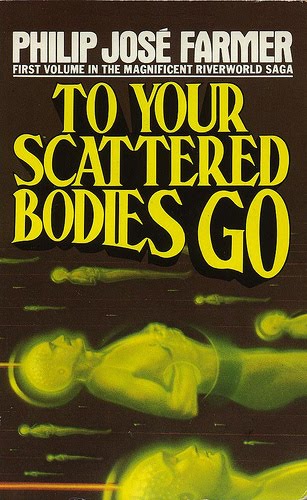
And it’s a historical figure who is the protagonist of To Your Scattered Bodies Go. He is Richard Burton, the Victorian explorer, discoverer of Lake Tanganyika, and translator of 1001 Nights and Kama Sutra. The novel opens with him waking up in a vast space, whose limits he cannot see, floating in some sort of clear gel and surrounded by rank upon rank of sleeping human beings. He attempts to escape, but is caught and returned to sleep… only to awake at the side of the River.
The entire population of Earth from its entire history has been dumped along the River. Burton finds himself the leader of a small group which includes Alice Liddell Hargreaves (Carroll’s inspiration for Alice’s Adventures in Wonderland) and a number of fictional characters – including a Neanderthal (I think), and an alien from Tau Ceti (who apparently visited the Earth at the start of the twenty-first century).
Each person arrives on Riverworld with nothing but a “grail”, which is a sort of tiffin tin. Every mile along the River are “grailstones”, large mushroom-shaped stones with rings of depressions on their tops into which the grails fit. Twice a day, grails left in the depressions are filled with food, alcoholic drinks, soap, cigarettes, and other items. Initially, everyone is naked, and Farmer is keen to get this across, describing it more often than is really necessary. Later, the grails provide simple garments – kilts, halter-tops and the like.
To Your Scattered Bodies Go does not present a cheering vision of humanity. Not content with having the resurrected humans display the worst elements of their nature during the first few days after their arrival on Riverworld, Farmer later has them banding together to form small nations, most of which fight each other or run slave economies.
After several chapters in which Burton et al explore their immediate surroundings and build huts – and little else except violent encounters occur – he decides to build a boat and travel up the River. Which he does – on a large catamaran, with a crew of a dozen, including Alice, the caveman, the Tau Cetan, and several others of his group.
They travel a great distance – “exactly 415 days later, they had passed 24,900 grailrocks” – and see a great many people – “they must have passed an estimated 44,370,000 people, at least”.
The journey comes to an abrupt end when the boat is attacked and its crew captured by a state ruled by Herman Goering and early Roman emperor Tullus Hostilius. These two have enslaved all those in their vicinity, letting them keep the food from their grails, but confiscating the luxury items – whiskey, narcotics, cigarettes, etc. Goering apparently managed to take control after whipping up anti-semitic feeling amongst the people around him.
Unfortunately, Riverworld, for all that its population contains all of human history, is nothing more than middle America. Farmer has obviously read a book on Richard Burton – perhaps even the one mentioned by another character, Burton: Arabian Nights Adventurer, Fairfax Downey (1931) – and so he made him his hero. But the Burton of To Your Scattered Bodies Go reads like an ordinary mid-twentieth century competent man, and his one historical quirk appears to be an impassioned defence – usually cut short – of writing a book repeatedly described as anti-semitic. In fact, To Your Scattered Bodies Go is full of anti-anti-semitism. Goering used anti-semitism as a route to power; one of the catamaran’s crew is a twentieth-century Jew who argues repeatedly with Burton; and after being enslaved by Goering, Burton and the others are imprisoned with a group of Israelis. Strangely, there are no Arabs in To Your Scattered Bodies Go. And Burton, who spent so long in the Arab world – and was the first European to visit Makka – never discusses Islam.
Then there’s the cigarettes… Yes, more people are alive today than have lived throughout history, but is it really plausible to expect cigarettes to feature so heavily in Riverworld? Perhaps it’s understandable that a sf short story submitted to a US magazine of the mid-twentieth century would be so parochial, but I’d have expected more of novel. Admittedly, two parts of To Your Scattered Bodies Go were originally published as short stories – ‘The Day of the Great Shout’ in 1965, and ‘Riverworld’ in 1966.
More than this, the story’s plot is fundamentally flawed. When Burton and the others are captured by Goering’s mob and enslaved, they immediately begin plotting an escape. They manage to break out and, in fact, seize power and remake the state along more egalitarian lines. But the whole slavery thing is flawed. Everyone already knows that if they die they are resurrected again, although not in the same area in which they died. So they could try to escape their enslavers – if they fail and are killed, well, they’ll just re-appear somewhere else. No one has any reason to accept slavery. Yet they do. It makes no sense.
And this means of “escape” later becomes a major plot point for Burton. He is being hunted by the builders of Riverworld – dubbed the “Ethicals” – and in order to stay out of their clutches, he repeatedly takes his own life – 777 times before finally being caught by them.
Like The Stainless Steel Rat earlier this year, To Your Scattered Bodies Go failed for me on this reread because it seemed little or no thought had been put into the story beyond its central premise. Burton is not a convincing recreation of the historical figure. And every period of history presented in the book is the same as twentieth-century America in its outlook and sensibilities. I need more than a neat idea for me to enjoy a story, and certainly more than that for me to think a story is any good. Perhaps it’s not all that surprising that, in a genre in which it’s now extremely difficult to come up with a new original idea because they’ve all been done, present-day sf readers tend to look at the stuff around the central premise – the world-building, the writing, rigour, plausibility, logic – in order to determine quality.
Despite my disappointment with To Your Scattered Bodies Go, I think I’ll hang onto to my Riverworld boxed set for the time-being. I’ve never been a big fan of Farmer’s fiction – in fact, I’ve always wanted to like his books more than I do, because he never seemed to approach the genre in an especially straight line like the other writers of his generation. One day, perhaps, I’ll read more by him.
 It Doesn't Have To Be Right...