To date, Gwyneth Jones has appeared on the Arthur C Clarke Award short list six times, and won it once – for Bold As Love in 2002. Only Stephen Baxter has been nominated more times, and he has yet to win the award. If Jones’ 2004 novel Life had been published in the UK, I suspect it too would have been short-listed – it did, after all, win the Philip K Dick Award for that year. As David Soyka wrote in his review of the book on on sfsite.com:
Simply, put, Life is one of the best things Jones has written. You can stop reading right now and go out and buy the book. Otherwise, you’ll have to endure yet another one of these diatribes about how science fiction doesn’t get any respect from the literary mainstream. Because you can’t read this book and not reflect on the fact that had this been written by, say, Margaret Atwood, Life would be receiving more of the widespread attention it deserves.
In other words, Gwyneth Jones is probably one of the best British science fiction writers currently being published. So a new novel by her is certain to be one worth reading. Spirit; or the Princess of Bois Dormant is her latest. It was published at the end of December 2008.
The plot of Spirit is based on that of The Count of Monte Cristo , but it shares its universe with the Aleutian trilogy of White Queen
 , North Wind
 and Phoenix Café
 . The universe has also featured in a number of Jones’ short stories, including ‘Saving Tiamaat’ in The New Space Opera
 (it can be read here); and ‘The Tomb Wife’, which has just been shortlisted for this year’s Nebula Award (it can be read here).
The shape of Dumas’ story is well-known: Dantès is falsely accused of treason, sentenced to life imprisonment in the Chateau d’If, befriended by a fellow prisoner who teaches him all manner of useful skills and knowledge, escapes, sets himself up in society using treasure whose location was given to him by his friend in prison… and subsequently has his revenge on those who conspired to send him to prison in the first place.
And Spirit does, in broad aspect, follow this. The novel’s protagonist is also unjustly imprisoned for twenty years, is educated while in prison, escapes and uses the “fortune” she was bequeathed by her mentor inside to… Not revenge, but neither is it justice. Call it a “balancing”.
Of course, Spirit is space opera – new space opera, in fact. The conspiracy which puts Dantès in prison was historical and reasonably well-known by readers. The conspiracy underlying Spirit is wholly invented; the world in which Spirit takes place is wholly invented. Which means the narrative of Jones’ protagonist – Gwibiwr; quickly shortened to Bibi – must begin much earlier than that of Dantès. It must give her origin, in fact. And the conspiracy which results in Bibi’s imprisonment must also be set up. It is not until halfway through Spirit that Bibi is actually sent to prison. This is not a criticism – Spirit is not about Bibi’s revenge, it is about Bibi. She is “the Princess of Bois Dormant”.
In the Aleutian trilogy, aliens arrived on Earth and precipitated a crisis. This led to the Gender Wars and, eventually, a World Republic. In Spirit, Jones has expanded this universe into an interstellar Hegemony of five worlds, ruled from a space station in the Kuiper Belt called Speranza. Each of the five worlds is the home of an “alien” race, although there is sufficient biological commonality between the various races to suggest Earth as a common home world in the ancient past. This is known as “having your cake and eating it”. A major theme of the Aleutian trilogy was colonialism, and Earth was the colonised; but in Spirit the humans – or “Blues”, as Earth is known as the Blue Planet – are the colonisers. The Hegemony also allows Jones to spread her commentary on gender and gender roles across societies that are very much other.
And there is plenty of cake to eat in Spirit. Not a Black Forest gateau or the like, not some fancy confection covered whipped cream and chocolate shavings. But a strong English fruitcake, steeped in brandy. Perhaps that’s too silly a conceit. Certainly Spirit contains plenty to chew on, not just the themes carried over from the Aleutian trilogy.
Admittedly, those themes strongly season the book, making Spirit very much a thematic sequel to Phoenix Café. But there are other ingredients: the opening section, in which Bibi grows up in semi-feudal Baykonur, has a flavour of Frank Herbert’s Dune . The sudden decamp to Speranza, and the explanation of the workings of the Hegemony’s interstellar transit network, contains pieces of Frederik Pohl’s Gateway
 . When Bibi is on Sigurt’s World as part of a diplomatic mission, and it all goes horribly wrong, Spirit tastes almost Banksian. And there’s a soupçon of Samuel Delany in the section set on Ki/An.
Also present are small nuggets of Jones’ earlier works: Escape Plans – the distributed systems of that book have become virtual, or 4-Space; and Kairos
 – travel via Buonarotti transit-pod mimics in some respects the effects of that novel’s eponymous drug.
All this is mixed in with The Count of Monte Cristo. And layered with new space opera as a mode of science fiction.
It makes for a rich and complex story; a story which, no matter how well stirred, can sometimes overwhelm the palate. As each new flavour or tang rises to the surface, so the focus of the story shifts. Bibi is not always there. At one point, for example, the story breaks away from her, simply so we can experience her ex-boyfriend laying another brick in the conspiracy which will condemn her. And in the final section of the book, the Princess of Bois Dormant has taken Bibi’s place entirely.
It is in fact that last section where Spirit becomes less the dish of its ingredients. Dumas serves this dish cold, but Jones is less focused on revenge. The Princess of Bois Dormant sets out to redress the wrongs done to her, but also to right the wrongs done to those who suffered because of her. Chief among the latter is her son, a prince of Sigurt’s World. This leads to an odd detour, following the prince’s holiday on Ki/An, his trip into the marshes, and his kidnap. Later on Speranza, the prince and his companion help rescue a pair of young women from the Traditionalist roles their family intend them to play. Both women are the daughters of Bibi’s enemies. Those enemies, of course, get their compeuppance, although Bibi seems to have little to do with it. One has a stroke, another is killed while trying to escape. It all seems a bit… incidental.
Not everything in Spirit works. I don’t understand Jones’ decision to pepper the names of the natives of Sigurt’s World with apostrophes, such as her alien prince D”ffyd. If it’s a joke, it soon wears thin. The many references to the French Revolution also seem to add little – despite the novel’s template, The Count of Monte Cristo; despite the novel’s title, Spirit, also referring to the Princess’s Aleutian transit-pod, Spirit of Eighty-Nine (1789, that is). And speaking of French… Sleeping Beauty in French is known as La Belle au Bois Dormant. Perhaps my French isn’t as good as it should be, but I thought the dormant (sleeping) referred to the belle (beauty) and not the bois (wood). La Princesse au Bois Dormant makes much more sense. And is especially ironic as the Interplanetary Prison Moon of Fenmu is a rocky inhospitable place, and Bibi spends twenty years there underground…
Spirit is an excellent novel. I’d have expected no less of Gwyneth Jones. I fully expect it to appear in my best novels of the year list for 2009. However, I suspect Spirit will not be on the short list for the Arthur C Clarke Award next year. It is too rich and complex a novel, and the Clarke seems to prefer works of a much stronger and more distinctive flavour. But I do think it will be on the BSFA Award short list – literate sf novels by British authors do well with the BSFA Award. And so they should.
Incidentally, 2009 should prove a good year for Jones. Spirit may have been published right at the end of 2008, but due during 2009 are a short-fiction collection from PS Publishing, Grazing the Long Acre; and a “Conversation Piece”, The Buonarotti Quartet, and a non-fiction collection, Imagination/Space, both from Aqueduct Press.
(Ah well. The cake-thing seemed like a good idea at the time. But never mind…)

 and
and  could certainly be considered classics of science fiction. And Jack Vance is certainly a classic sf author, and has written a couple of classic sf novels. But
  is not one of them. However, Vance has always been a singular voice in sf, and I’ve always liked his books. So sticking one of his titles on the list for my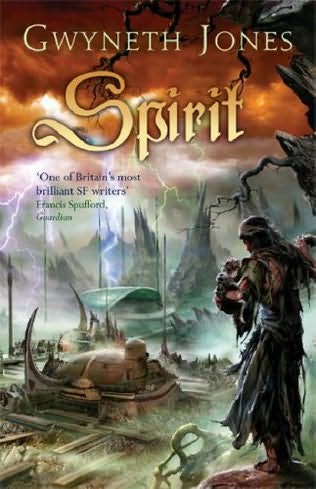
 It Doesn't Have To Be Right...